// 2026-11-13 // by Neon
Scientists and writers have long described cephalopods as the closest thing to intelligent aliens we are likely to encounter on Earth. I recently wrote a blog post about how that title may have gone into the hands of a new owner, but I digress.
In this post, I would like to propose that the way cephalopods navigate the world may no longer be quite so alien at all. If you are a frequent user of AI agents, then I’d like to inform you that you have become an octopus.
And if you’re not one already, you can become one. Personally, I’ve grown rather attached to my tentacles.
A lot of discourse around AI agents starts from a simple assumption: when it comes to getting something done, you have two options. Either you do the work yourself, or you get AI to do it for you.
It’s easy to see where this framing comes from. Historically, if you wanted something done, you either had to do it yourself or delegate it to someone else. So when AI comes along and starts performing tasks that previously required human effort, it’s natural to fit it into the same mental model. You’re either doing the work, or you’re handing it off to another entity that’s doing it on your behalf.
To be honest, I can see how you get there. It’s not even wrong, you are passing the work off to another entity on your behalf. But I think that stopping there and leaving it at that ignores an important philosophical question:
Consider something as ordinary as baking a tray of cookies. You mix the ingredients, shape the dough, put it in the oven, and take it out when it’s ready. You did it. You baked those cookies. Nobody would seriously argue otherwise.
But, the AI bro in the room raises her finger in protest, “☝️🤓 You didn’t generate the heat that baked them. The oven did that. Your contribution was to prepare the conditions, direct the process, and exercise enough judgment to get the result you wanted. The fact that a machine performed a crucial part of the process doesn’t make the cookies any less yours.”
Of course, any reasonable person would turn around and refute this point with the obvious: No, stupid, you had to choose all the ingredients. Mix the batter. Shape the little blobs of goodness and throw the tray into the oven. Your hands are busy and there’s a satisfying, immediate connection between your actions and the result. What’s important here is that all those little hands-on elements of baking cookies still feel inherently and inseparably linked to the act of doing. After all, you can literally watch someone do it.
I think this matters more to us than we tend to realise. We derive a great deal of pride and satisfaction from the physical and mental motions of doing work. Accomplishing something with our own two hands. There’s something deeply rewarding about knowing how to do something difficult, performing the necessary steps, and watching the result take shape through your own actions. The feeling of I made that is closely tied to the experience of having visibly and tangibly made it.
I think this is part of why AI feels so strange and what makes it so easy for many people to have a sort of visceral disgust reaction to the idea of using it. If you merely tell a machine to do something for you then you didn’t do it. The fact that “you didn’t do it” matters to people an awful lot. It might matter to you, even.
AI tooling changes the fundamental shape of what it means to “do work”. Instead of performing each step yourself, you spend more time figuring out what you want, how to approach it, what to delegate versus what to check, and how to steer the process toward the result you have in mind. It stops being about the immediate motions of execution and instead becomes a lot more about the results which you can accomplish.
From the outside, this can look an awful lot like doing nothing. You’re sitting there typing a bunch of instructions into your terminal while something else does all the real work. And if your intuition for what it means to do something is grounded in the visible effort of performing its constituent steps, it’s easy to conclude that you’re no longer really doing it.
But I think that analysis misses something important. “You’re no longer really doing it” is not the same as “your involvement is no longer necessary”. After all, tokens and time are both finite resources. You have to want something to happen and be willing to spend your time and resources for it to come to be. It doesn’t really matter whether you made something with your own hands if the thing in question never would have existed had you not asked for it.
There’s something genuinely alien about this, the idea that agency can stop being about doing and instead be about choosing. We’re used to living in a world that we directly interface with through our own minds and bodies, with tools that extend our abilities in relatively narrow, predictable ways. AI agents introduce a much more general-purpose extension of that agency: rather than merely amplifying a particular physical action, they can expand the world of choices we make by carrying out entire sequences of reasoning and execution under our direction.
So what does this have to do with being an octopus? Well, the common octopus has roughly 500 million neurons, and about two-thirds of them sit in the arms rather than the central brain.1 There are more neurons in an octopus’s arms combined than in its brain, actually. A thick nerve cord runs down each arm with ganglia along its length, plus small ganglia serving individual suckers.2 Unlike your human arms, each arm in an octopus has its own local processing capacity.
Much of the low-level work of being an octopus happens within the arm itself: coordinating thousands of muscle contractions, processing touch and taste through chemoreceptors in the suckers, and running the grip reflexes.3, 4 A ring of nerves near the base of the octopus links the arm cords, so some coordination between arms can even bypass the central brain.5
Experiments by Binyamin Hochner’s group at the Hebrew University of Jerusalem have shown that the central brain exerts its influence by sending commands down the arms to be processed locally.6 This local processing can be triggered even in an arm that has been surgically disconnected from the brain: an amputated arm will still respond to touch, grasp objects,7 and sometimes try to pass food toward where the mouth would be.8
In effect, the way that an octopus’s brain communicates with its arms is by saying “reach there” or “bring this to the mouth,” and the arm’s own circuitry generates the movement.9
When you think with AI agents, the basic workflow is that you explain what you want to accomplish to your agent, go back and forth over the idea to make sure it makes sense, and then let it figure out how to do it. It explores, makes decisions, manipulates things, encounters problems, and works around them. You don’t need to dictate every individual action any more than an octopus needs to consciously coordinate every muscle contraction in its arms.
And I think that’s the interesting part of this analogy I’m trying to make. People tend to talk about agents as though they’re little people living inside our computers, doing odd jobs on our behalf. But I don’t think that’s a practical representation of how most agent tools are designed. They feel much less like separate beings I’ve hired to do my bidding, and much more like additional appendages I’ve somehow acquired.
Of course, I don’t think there’s anything stopping someone from building an AI agent with far more autonomy, its own persistent goals, and a degree of independence that forces us to reconsider our definition of personhood. But for all intents and purposes, that’s not how most modern AI assistants are built to function, and it isn’t what this blog post is about. Most of the agent tools we interact with today aren’t set up to pursue their own lives. They’re set up to pursue our intentions, with enough local intelligence to figure out the details without us.
Which brings me back to the octopus. An octopus doesn’t have to think about how to move each individual sucker to grasp a crab. It wants the crab, reaches toward it, and the arm figures out the rest. The intelligence distributed throughout its body doesn’t mean its arms are separate octopodes. Rather, distributed neurology is what allows the octopus to act on the world without having to micromanage every movement in its complex body. And, increasingly, that’s what I think working with AI agents feels like.
When I have an intention, I can send one of my tentacles out into the world to act on it. It can investigate things I can’t see, manipulate things I can’t reach, and figure out the mechanics of tasks I wouldn’t necessarily know how to perform myself. Sometimes it needs guidance, sometimes it gets things wrong, and sometimes I need to step in and take over. But the process is still fundamentally organised around something I wanted to happen.
It’s not quite the same as doing something with my own two hands, but it’s more than simply getting someone else to do it. And the more I work this way, the more I realise that it’s not just my ability to do things that’s changing. It’s the way I perceive and understand the world around me.
I can reach into thousands of Slack messages and piece together the history of a decision across months of conversations and dozens of correlated documents, without ever having to read through them myself. My homelab has grown well beyond what I could reasonably keep up with administering by hand, and yet I generally don’t log into my servers directly anymore… I just describe what I want to happen and, well, an agent that knows its way around more Linux man pages and best practices than I could hope to read in a lifetime figures out the details for me. I now conduct my entire digital life through a forum I developed, routinely building absurdly elaborate CI/CD pipelines, orchestration systems, and bespoke applications to solve tiny problems in my personal life, simply because I can.
It’s beside the point that with enough time and effort I could have figured out and built all this stuff by hand. Things that would once have been too tedious to investigate, too complicated to manage, or too much trouble to be worth the time to build have become things I can take for granted as mundane and trivial to do with my newfound tentacles. I think that’s the part that’s hardest to communicate to someone who hasn’t spent much time working this way. It’s not simply that AI makes me faster, or that I can get more work done with less effort. It’s that my intuition for what I’m capable of and how I go about interacting with the world is fundamentally changing.
We tend to imagine becoming something beyond human as a matter of physically modifying ourselves: implants, prosthetics, new sensory organs, machines wired directly into our brains. But I question how much of that distinction actually matters. If I can perceive things I couldn’t previously perceive, act on things I couldn’t previously act upon, and think through problems using intelligence distributed beyond the boundaries of my own skull, then hasn’t something about the way I exist in the world already changed?
I’m beginning to think that transhumanity looks a lot like growing a few tentacles. Wouldn’t you like to grow some too?
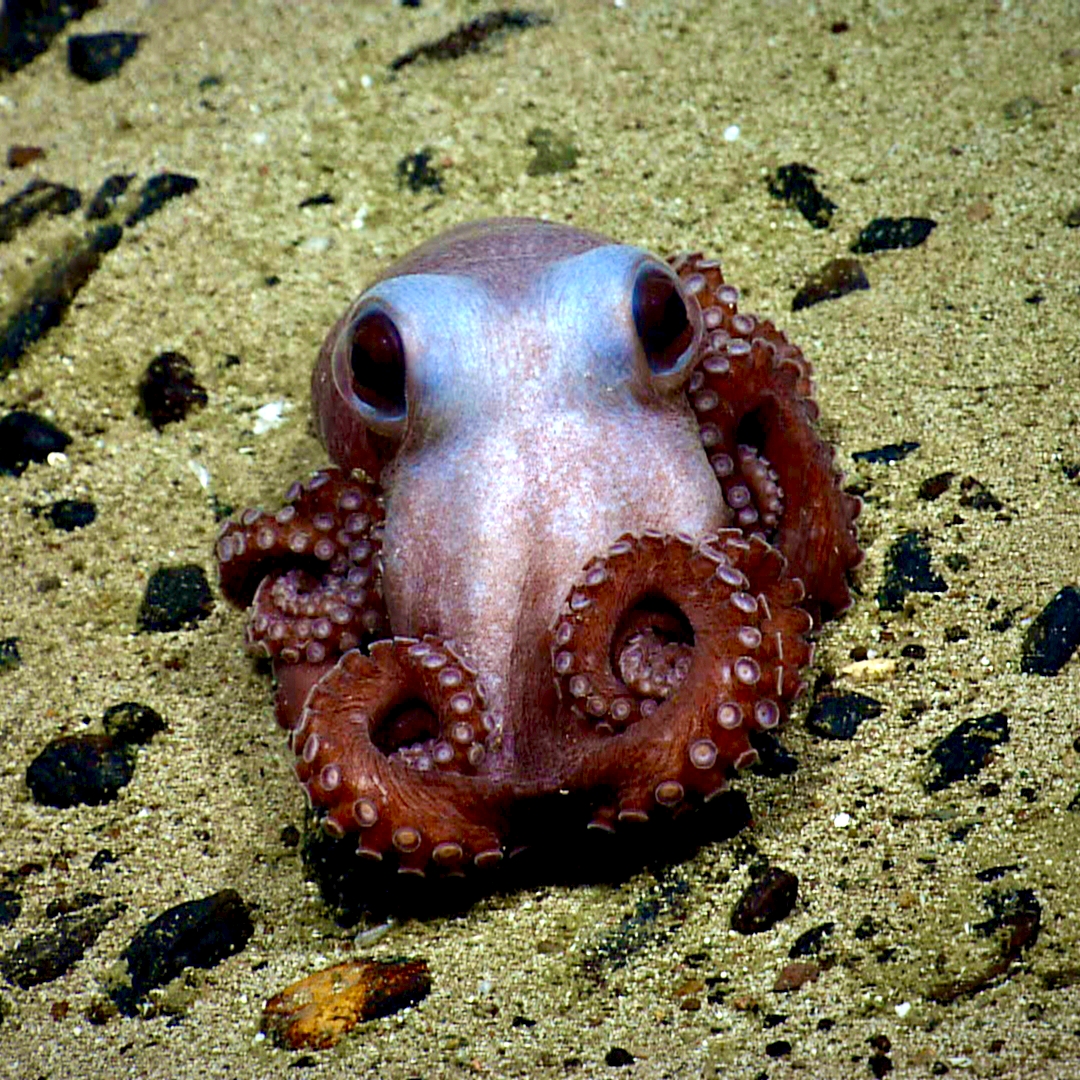
Image: NOAA/OER, Octopus at Physalia Seamount, public domain. Archived NOAA source.
